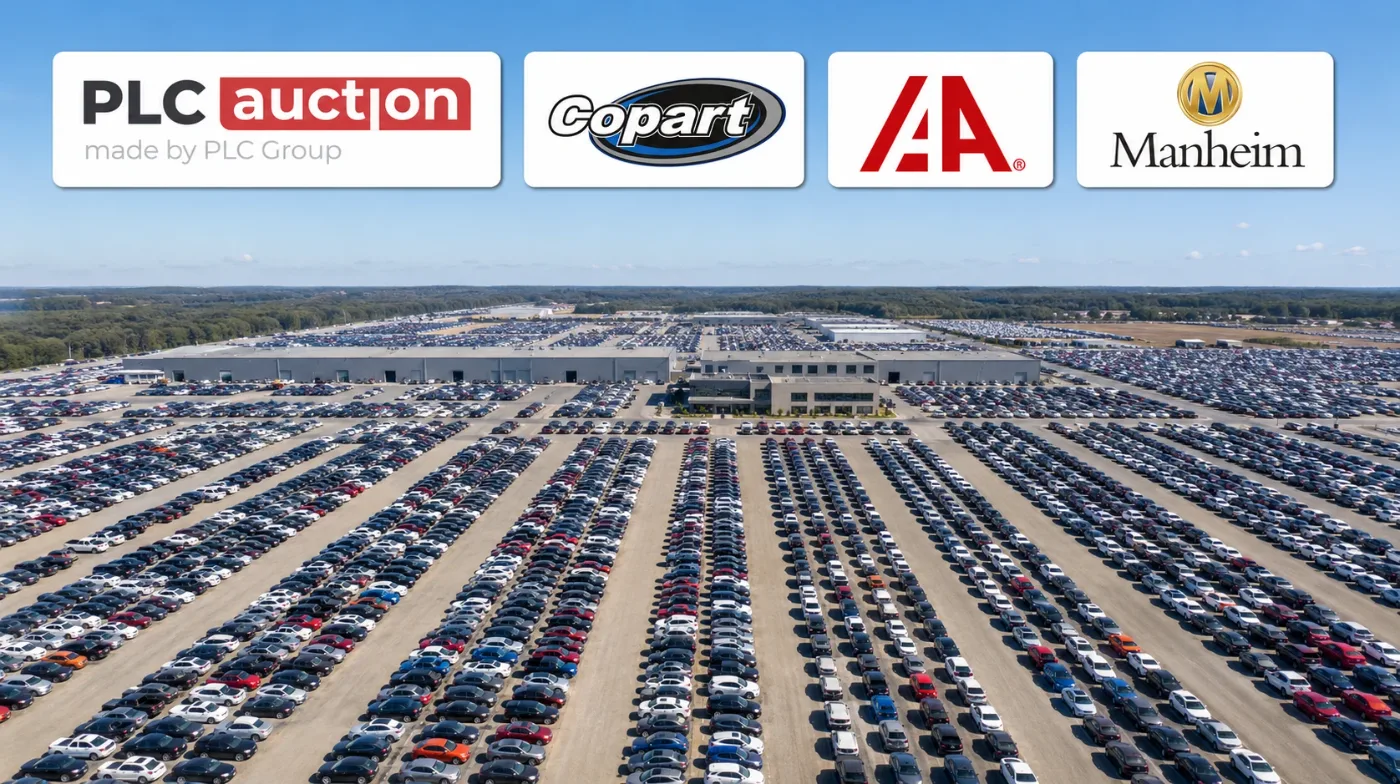
A lot at a US auction is a few photos, a short description of the damage, the title type and a few technical marks. That is all. You will not see the car in person or start it. That is why the ability to read this data is not an extra option but exactly what you pay for when buying a car from the USA. Below is what we look at when we prepare a lot for a bid, and where people who bid on their own most often go wrong.
What lot photos show — and what they hide
The photos are taken quickly and in the same way: the body from several angles, the interior, the instrument panel, sometimes the engine bay and the VIN plate. They are shot right at the yard, often against the sun, and nobody washes a dirty car. So the photos show the geometry and major damage well — and almost none of the small things.
The gaps between the hood and the fender, the doors and the pillar: if the gap is different on one side, the body is most likely bent.
The position of the wheels. A wheel that stands at an angle or is shifted in the arch already means the suspension, and often the frame rail.
The instrument panel. Many lots have a shot with the ignition on: you can see the mileage and which warning lights are on (ABS, SRS, Check Engine).
The interior. A cut steering wheel and an opened dashboard mean the airbags have deployed, even if the description says not a word about it.
Traces of loading: scratched sills, torn-off plastic underneath — the car has already been dragged and put on a tow truck.
What the photos almost never show: the condition of the engine and transmission, corrosion, traces of water in the sills, the quality of a previous repair. This is worth keeping in mind at all times. A photo is a reason to ask a question, not an answer to it.
How to read Primary damage and Secondary damage
The auction lists the primary and secondary damage: Front End, Rear End, Side, All Over, Undercarriage, Water or Flood, Vandalism, Mechanical, Normal Wear. These codes are set by the check-in clerk in a few minutes, without taking anything apart. They are approximate and should be read together with the photos.
Front End with an intact windshield and undeployed airbags is usually a low-speed impact: bumper, lights, radiator.
Front End plus deployed airbags is a completely different amount: SRS, seat belts, dashboard, often the front body panel and the frame rails.
All Over is either hail or several areas at once. Hail is cheap until it comes to replacing the glass and the roof.
Mechanical means the engine or transmission. The least predictable category: the auction does not determine or describe the cause.
Undercarriage is an impact to the underbody. Look at the subframe, the exhaust, the oil pan, and for electric cars at the battery housing.
Normal Wear means there is no damage; the car came from a lease, a rental fleet or a confiscation. Such lots go for more, and that is normal.
Which damage is critical and which is cosmetic
A simple rule: everything that is bolted on means money and time. Everything that is welded or sets the body geometry means risk.
Cosmetic: bumpers, fenders, doors, hood, lights, glass, mirrors. It can be expensive because of the price of original parts, but the amount is calculated in advance and hardly changes.
Serious: frame rails, strut towers, pillars, sills, the rear panel, the subframe. This needs a frame jig, and the result depends heavily on the technician.
Expensive and invisible: deployed airbags. A set with seat belts and the control unit sometimes costs more than the entire exterior repair.
Worst of all: water. It cannot be seen in the photos, it is not cured by drying, and it does not show up right away — through oxidized connectors, control units that start living their own life, corrosion from the inside.
A separate note on electric cars and hybrids. An impact in the battery area or any contact with water moves a lot into the category where the repair may exceed the value of the car itself. Here either the battery condition is clear, or we simply do not bid.
Why a “clean” title is not a guarantee
A title is the legal status of a car in a specific state, not an assessment of its condition. Clean only means that the insurer did not write the car off as a total loss and the state did not put a brand on it. It says nothing about the quality of repairs or the real history.
If the owner repaired the car at their own expense without going to the insurer, a brand will not appear at all — yet the car was damaged.
Branding rules depend on the state, and a car can be re-titled where the requirements are softer. This is an old practice called title washing.
And the other way round: Salvage or Rebuilt is not an automatic verdict. What matters is why exactly the car got this status. Salvage because of hail and salvage because of a frontal impact with airbags are different cars and different budgets.
That is why we read the title together with the VIN history report, the photos and the damage description. When these three sources contradict each other, that is reason enough to skip the lot and take the next one.
Run and Drive, keys, mileage status: what they really mean
These are the lines of the description that are most often misunderstood.
Run and Drive means that at the check-in yard the car started, drove a few meters and stopped. This is not a test drive and not diagnostics. The condition of the transmission, the compression and the remaining life of the timing chain stay unknown.
The absence of this mark does not always mean a fault. The car may have arrived without a key, with a dead battery or with an empty tank.
Keys: No is not critical, but it adds the cost of making and programming a key, and for some makes this is a noticeable amount.
Mileage has a status: Actual, Not Actual (TMU) or Exempt. Exempt usually applies to older cars for which declaring the mileage is not required, which means nobody confirmed the figure on the odometer.
What else you can find out before the bid, and what you cannot
The logical question after all of the above: can you look at the car more closely before the bidding closes? There are partial answers, and you need to ask about them in advance — after the lot closes there is nothing left to ask about.
A VIN history report. It will not show the quality of repairs, but it will show recorded events, changes of owners and service records. We order one for every lot we take on.
Additional photos and video from the yard. We send a photo and video report on the car’s condition before the bidding, not after the purchase: it is not a substitute for diagnostics, but it is much more than a dozen shots in the lot.
Paid inspections by third parties exist at some yards as a separate market service. If you are considering this option, find out the terms and timelines before the auction day.
What no source will give you before the purchase: compression, the remaining life of the transmission, the condition of the timing chain and the effects of water that has already been dried out. This cannot be guessed; it is built into the budget as a reserve.
The conclusion is simple: the more expensive the car and the more seriously the front is damaged, the more sense it makes to spend time on checks before the bid. On a cheap lot with hail damage this step is often unnecessary.
A sequence of steps that really reduces the risk
Calculate the turnkey budget together with customs payments and a reserve for repairs, not just the bid.
Rule out right away the categories you are not ready to take on: water, serious geometry damage, mechanical without diagnostics.
Check the VIN history and compare it with the photos and the title type.
For lots on the shortlist, collect as much material as possible: additional photos, video, shots of the problem areas.
Set a maximum bid — and do not raise it during the bidding. Getting carried away at an auction costs more than any damage.
The most expensive mistake with an auction car is not a missed scratch but a misread line: “clean title” instead of “unknown history”, “run and drive” instead of “the engine is fine”. At KTrans we import cars from the USA and are responsible for selecting the lots ourselves, so we read these lines before the bid, not after. If you are already looking at specific lots, send us the links, and we will tell you what we see in the photos and the description and where the budget is hiding in that lot.